
[making] SENSE OF [a] PLACE
Published: Transform: Australian Institute Landscape Architects 2011 National Conference, Brisbane Queensland Australia
Authors: Greg Grabasch, Cristina B Gibson (UWA Business School) and Stephen Gibson (Senior Landscape Architect UDLA)
Abstract:
At present the Pilbara and Kimberley communities in North Western Australia are experiencing unprecedented growth and transformation on the back of a booming extractive industries market. This growth is being supported economically by WA’s State Government’s regionally directed ‘royalty for regions’ or ‘R 4 R’ funding. While most of this funding has been aimed at basic housing and infrastructure shortages, there is a growing recognition to provide greater human amenity within these remote towns to attract families and a stable workforce.
Greg will present an overview of UDLA’s project involvement and report on their teams ongoing learning’s and experiences within the understanding that transforming contemporary regional communities continues to require an integrated design approach, highlighting the realisation that robust solutions are often found between disciplines and LA’s are well placed to recognise and coordinate these findings.
Operating at the meso-level, Greg will share the theoretical frameworks which underpin their teams approach and endeavour to illustrate individualised steps for a number of their community development case studies, in turn highlighting the role of Landscape Architects within this multidisciplinary process.
Approach
This paper introduces an approach to community design facilitation that endeavours to build capacity in order to contribute to the sustainability of the community across social, cultural, ecological, and economic contexts.
Greg Grabasch and his Fremantle based design team UDLA, utilises a design process that endeavours to integrate the principals of human scale development found in the Community Development literature (Neef, 1991; Laverack, 2005), hypotheses of social and resource mobilisation found in Social Movement Theory (Kornhauser, 1959; Smelser, 1963; Melucci, 1989) and the benefits of social empowerment through approaches such as The Environmental Justice Movement (Schlosberg, 2007; Bryant, 1995; McDonald, 2002; Rhodes, 2003). Each of these theoretical foundations addresses components that are critical to the success of community engagement practices.
Our teams approach reflects growing acknowledgement among scholars that the term environment has expanded to include not only traditional ecological elements, but also those of a social nature, ultimately incorporating natural environment (Johnson et al, 1997), built environment (Brugmann, 2009), and social environment (Case, 2003). The result of this shift in philosophy is that the “environment” is now considered to include a place where people live, work, play (and pray). Coupled with this is the recognition that to achieve extensive sustainability objectives, there must be equitable spatial distributions of burdens across ethnic minorities and other groups; sustainability cannot be achieved if such burdens are placed only on the disadvantaged in society (Schlosberg, 2007).
Our basic philosophy for community design facilitation is to empower the people in the community itself to make the decisions, propose the policies, and guide the design of their own spaces. At the centre of it all is engagement with the community in a way that assists in building their capacity. This approach requires purging traditional design practice to redefine the design field as comprised of design facilitation, rather than consultation.
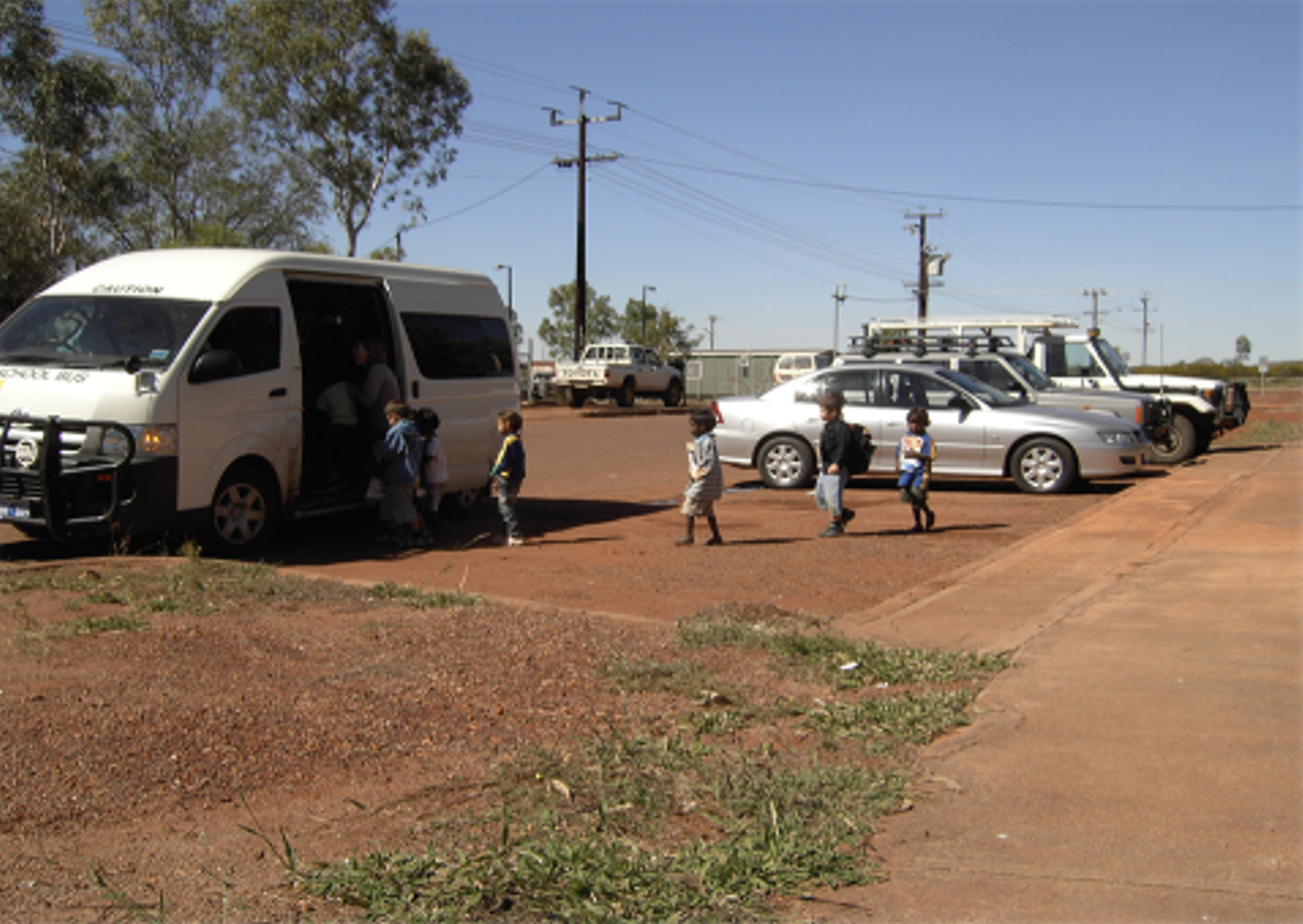
Kindergarten ‘home time’ Halls Creek NW WA
First Impressions
In the North Western expanse of Australia, especially the Pilbara and Kimberley regions, township development has taken a pragmatic lifestyle approach. Spaces are viewed as utilitarian, structured for efficient use, perhaps at first out of necessity. Yet more than 40 years has elapsed and this pragmatic approach is still the norm for most isolated mining or extractive industry townships based in the North West.
There is a rugged naivety and purpose in this approach, much like a young bachelor using his new pad to grease his motorbike, scatter his dirty washing, and lay out his toolbox. As a generalisation, a bachelor is unlikely to consider the new window dressing that will filter the afternoon sunlight, and enhance the experience of reading a book on the carefully selected furniture. How things can change when that special life partner shows up on the scene!
In a similar manner, many North Western towns have acquired a rugged built form, rolling out masculine engineered spaces that although highly practical for large vehicle use, often lack attention to the design of social places, human amenity for people to engage with and inspire respect of place.
This regional development and spatial typology, evident within many Western Australia frontier towns, has continually escaped serious critique. Yet the media continues to report increasing social problems, cultural disparity, and communities with filled with low self-esteem, drinking problems, workers and professionals who would rather fly in and fly out than live in, and contribute to, these communities.
But does this necessarily have to be the case? Are there counter-examples? There were actually other Australian towns that were developed on the back of an extractive industry boom, the mid 19th century, such as Kalgoorlie, Bendigo and Ballarat.
A speedy inquiry into Bendigo’s ‘chronological development’ notes that the town area was settled in 1851, proclaimed a municipality in 1855, a borough in 1863 and a city in 1871. Within 20 years ‘Bendigo’s legacy already included all the magnificent town parklands and ornate buildings built in the late Victorian colonial style, contributing to a picturesque "French" cityscape that has amenity value today. All other towns, even silver and tin mining towns of this era included wealth being distributed back into the development of local public amenity.
The ‘Churn’
In contrast, Western Australia’s North West extractive industry towns have been caught in the ‘churn’ of short stay populations.
Often referred to as a fly in fly out or ‘FIFO’ the norm becomes an economically driven population that can permanently live at their preferred amenity and commute for short periods, with the longest semi permanent stays being up to two years.
Perhaps most damaging, the “short stay” population includes key professionals such as local government officers, representing a loss of vital local experience.
Due to various reasons including long work hours, the FIFO participant does not tend to add or participate in building local community amenity and capacity.
A report Fly In / Fly Out: A Sustainability Perspective was prepared for the Chamber of Minerals and Energy WA January 2005 with the aim to provide a balance view on sustainable long distance commuting ‘LDC’.
With regard to the development of townships, the report explained that an increase in FIFO practices was due to the fact that “present economic reform exposed Australian exporters to global competitive pressures.” FIFO increased competitiveness by reducing costs (consistent with the view that the development of entire towns was no longer economically viable); it addressed skills shortages by providing an attractive employment option; and it helped to meet the lifestyle expectations of workers and families.
From the above report and earlier historic comparisons it is reasonable to assume that contemporary service-based regional town development is strongly guided by our present socio-economic condition. Yet there are techniques that can help to reduce the dysfunctional consequences, and improve the sustainability of development across social, cultural, ecological, and economic outcomes.
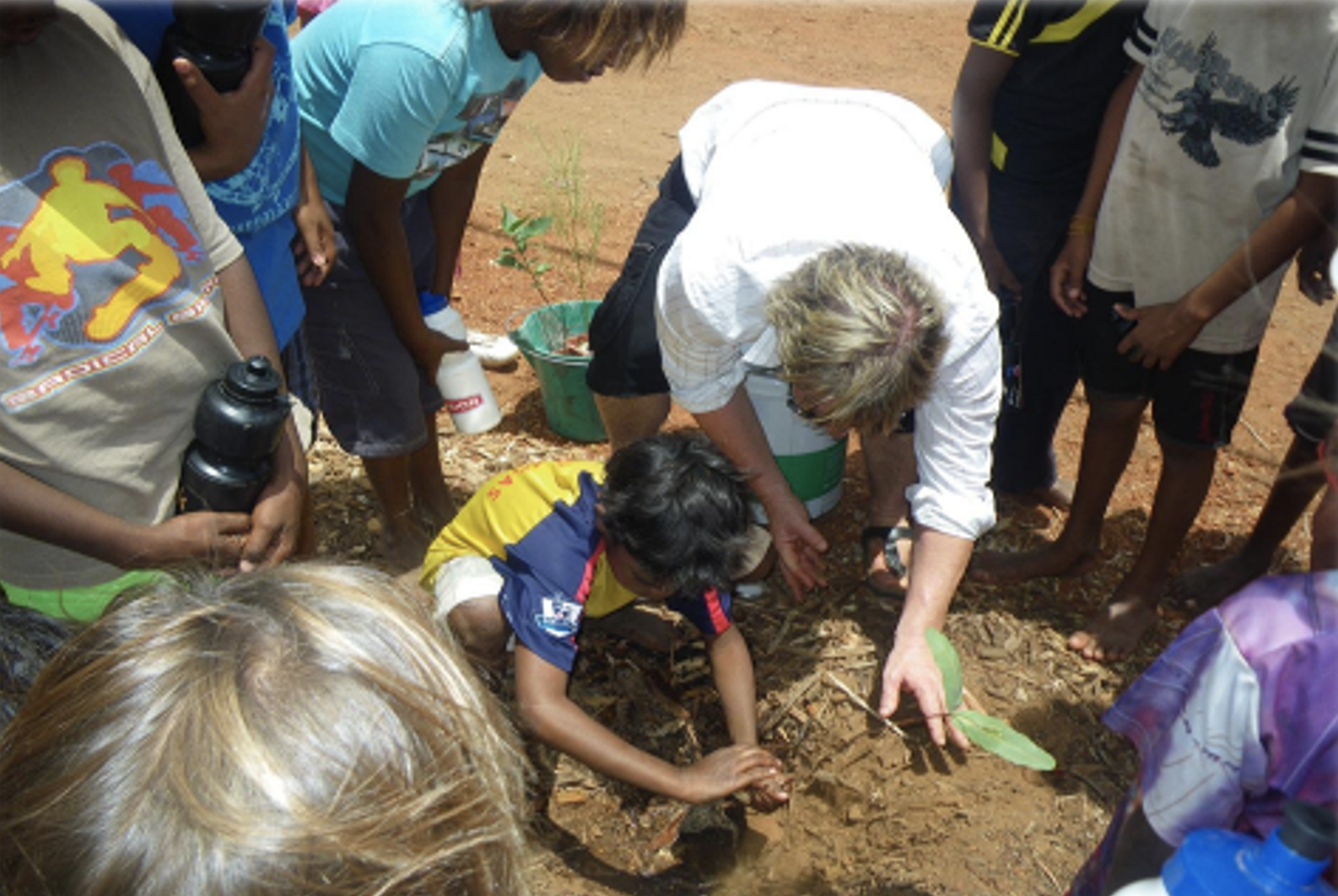
Bush Garden Planting Day, Halls Creek 2009
Case Study
Working effectively with the complex condition that shapes North West Australian communities lies within a multidisciplinatory approach to which Landscape Architecture has the opportunity to assist with the provision of equitable open space.
From ongoing experience our team have acknowledged four critical phases to aid this process: - Understanding, Relationships, Engagement, Facilitation - each of which contribute to a more sensitive approach to recognising the community’s existing health or capacity level and applying local experience. The ultimate aim is to enhance sustainable outcomes for the community.
Understanding
Our team often ask do we have the right to stick our noses into communities with the purpose of transformation?
Therefore we commence with the initial phase we call Understanding. This phase of community engagement commences prior to first contact. Practitioners must understand the community’s environment (ecological, social, and economic), the history, which events and beliefs have shaped their current existence, and the degree to which there is currently capacity in the community.
As our main case study we introduce the Halls Creek Township. A small town of 1,300 residents that services surrounding mining leases, pastoralists, Aboriginal communities, and travellers located on the edge of the Great Sandy Desert. The indigenous Jaru, Kija, and Tjurabalan peoples who represent over 60% of the town's population have a recent history of working cattle stations, leading to a strong sustained connection to the land. This connection was finally severed when equal pay was introduced in the 1950’s.
Present day Halls Creek is infamous in Australia due to the poor living and health conditions. For example, it is estimated that 90 percent of pregnant women in the town are alcoholic, with nearly a third of babies suffering Fetal Alcohol Syndrome (www.abc.net.au). Unfortunately, the situation in Halls Creek is not atypical for desert regional centres, and living conditions are known to be generally poor among indigenous populations around the globe.
In this phase of understanding, the primary role of the multinational firms, government agencies, or other organisations who may be involved in the design effort are to serve as repositories of knowledge. For example, many multinational mining companies sponsor social impact studies which develop baseline measures of various features of the communities they plan to enter in order to do business. Availability of such knowledge to all parties involved in community development is critical.
Relationships
The second phase focuses on Relationships.
In 2006, a WA government land development agency (LandCorp) appointed UDLA to coordinate and guide a community inspired opportunity in Halls Creek.
The project commenced on a formal and official level with the Shire of Halls Creek and LandCorp inviting the community to a large luncheon meeting. Unfortunately, there was a community ‘no show’!
From this experience we soon realised the importance of meeting people on their own terms and from that afternoon, started developing informal meeting opportunities. This continued for a number of months until relationships and a level of trust was developed. This included developing the understanding that our team was not just another ‘blow in’ that promised the world and yet failed to see the community opportunity through to full realisation.
As stories were gathered community objectives soon became manifest. Techniques for optimal participation also evolved, such as working with established community groups, rather than imposing purpose built committees. It became evident that active people within the community were already stretched, often over worked keeping abreast of many menial community tasks. Finding a way to support these champions in the community can often be the beginnings of allowing space for the community to develop or grow in new directions.
By adopting a very grassroots approach, we were able to unearth community champions that were passionate, personally embraced the project opportunity, and therefore could create capacity to take on the responsibility that was to follow.
We learned that it is important for the facilitator to recognise not only the present day community capacity, but also the champions capacity to take on new projects and how far this can be lifted.
Although a quick digression, it is interesting to note that these processes are not Australia-specific. Recently in Penang, we were fortunate to be introduced to a passionate heritage Architect, Ooi Bok Kim who is design-facilitating a number of urban community projects for the City and in particular has been involved with the Chew Jetty Community Project.
The Chew Clan Jetty or She Chew Keo is the largest Chinese Clan Jetty community that organically formed to provide location labour for unloading cargo ships in the early development of Penang (est. early 19th C). Members of the Chew Clan community originate from the same region in China.
Apart from the Chew Jetty community having a physical input into improving their living environment Ooi Bok Kim worked closely with the community spokesman (champion) Chew Kok Wah who had the capacity to help lift, engage and empower individuals into action. Kim Bok embodies the spirit of what we have been trying to achieve in the Western desert.
During the relationship building phase, the creation of trust is imperative to opening the channels of communication between members of the engagement team and the residents and stakeholders in a community.
Depending on cultural norms, this may involve many hours of social interaction and discussion. Designers involved in the Halls Creek project undertook relationship building activities spanning approximately 12 months, using a very personal style of interaction to gain an appropriate level of trust. This was critical in the Halls Creek context.
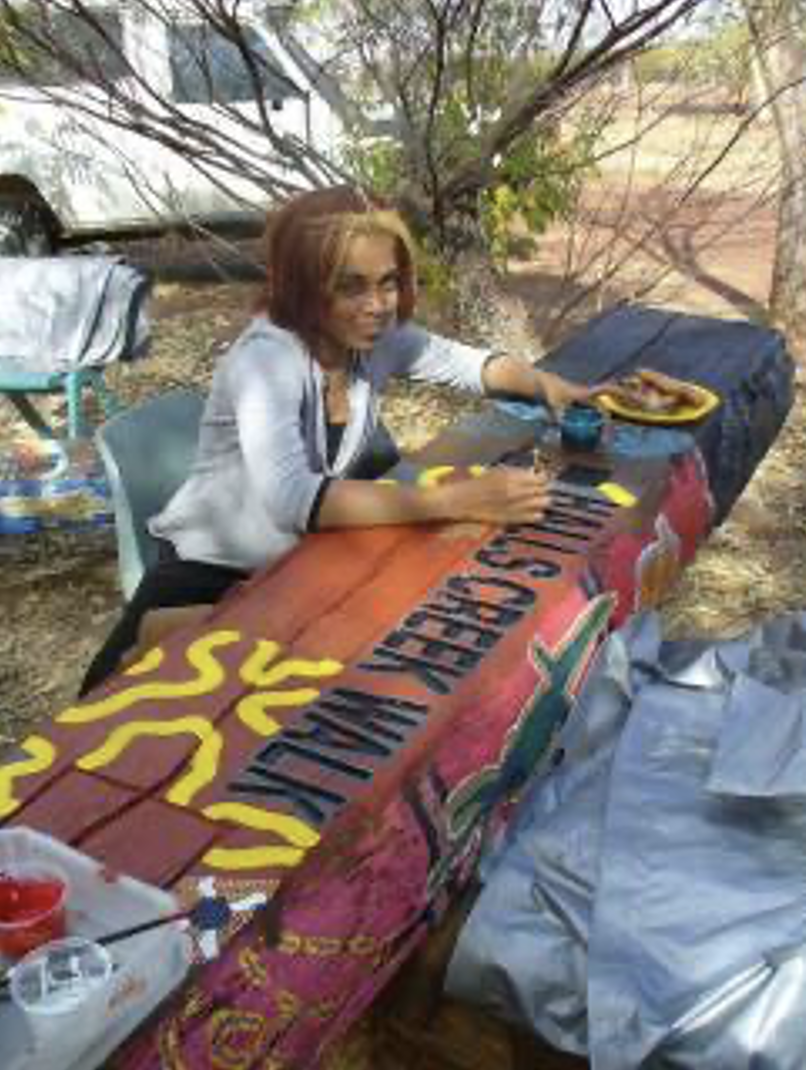
Halls Creek Walk - in progress
Engagement
The third phase of the community design process is Engagement. This phase involves the designer becoming a facilitator rather than providing an adversarial and/ or God-like approach to community design decisions.
Such an approach is quite contrary to the typical design process endorsed by many design professionals who use their education and experience as the key driving force in their design resolutions. Following careful design guidance from the facilitator includes sharing educational tools such as design analysis, evaluation, use of similar project precedents and concept development options. This phase directly places the community within the design process. If performed correctly, the capacity of the community is increased and there are also substantial benefits to the design outcome.
As with the second phase, the primary role of any organisations or client involved in this phase is as a broker for connections, but it is also critical that client representatives show support and openness to the ideas, needs, and priorities expressed during community engagement, to encourage broad and on-going participation. It is often stated that a projects level of success often depends on a good client; in particular a client that is open to design development.
The notion of story-telling is an integral part of Aboriginal culture and had to be acknowledged for this phase to be successful. According to anthropologist Fred Meyer (1986), who conducted ethnographies of the Pintupi people, in some Aboriginal languages, the direct translation of the word “ownership” is “the right to be asked.” Accordingly, Australian Indigenous populations and communities in Western Australia often simply want someone to listen to them tell their story. In this phase, organizations involved can help to broker connections with members of the community, who are sometimes employed by the firms. They can also sponsor forums and venues in which the connections can occur.
Facilitation
The final phase of the design process is Facilitation. During this phase, design solutions are collaboratively derived that engender further successful development.
Facilitation and coordination practices continue beyond the design itself, in order to assist the community in finalising their community development project, leading to a sustainable result that produces a strong sense of ownership over the result for the community. It then no longer becomes the “designer’s project,” rather it is the community’s project. Organizations involved can provide on-going resources for the maintenance of the community development efforts, as well as work to publicise success stories. There is very broad diversity in client/organisational policy and behaviour in this regard. Some companies essentially engage in symbolic activities or “window dressing” to create an impression of commitment to community development, others display a genuine commitment by expending substantial recourses that go well beyond any legal obligations (O’Faircheallaign, 2006).
For true sustainability, the latter is essential. Further evidence of the efficacy of this process is evident in a statistic presented by Gilbert Rochecouste of Village Well, an internationally renowned place-making specialist, who states that “20% of the success of a space is about the built environment; the other 80% is how people actually use it” (Personal Communication, 2010).
The Halls Creek project culminated in a community designed and implemented town walk, including associated interactive opportunities.
Features include themed interpretive stations, totem signage, an historic trackers hut and “bush tucker” gardens in which traditional desert food is grown and harvested. A hallmark of the project, the totems were produced by local artists and the residents themselves; they are an artistic rendition of residents’ own personal stories. The Halls Creek project has a solid foundation of community facilitated design and implementation, enabling the project to reflect local character and pride.
The community engaged project has spawned several entrepreneurial ventures in the community, which together now constitute a tourist destination, cultural heritage site, and another revenue stream for the community. Hence the design process has built community capacity and increased the sustainability of the community.
Summary
In summary, the successful development of this approach hinges on education and sensitive exposure to the community.
Conducted correctly, this process has shown to achieve both increased community capacity and sustainable community outcomes.