Surveying Southwest Sky Country
Published: Wild Magazine, Summer 2024
Author: Joe Bean
Renowned for its challenging walking, Tasmania’s South Coast Track is an ecological sanctuary and a place of precious darkness. But a proposal to build a string of private lodges along it threatens its delicate balance.
The South Coast Track, like so many areas in Lutruwita/Tasmania, is a precious place of wilderness. It is an ancient Aboriginal route, a place of rich Aboriginal heritage that reverberates through the sea, the rocks and the sky. It is a jewel of the Southwest, and part of the iconic Tasmanian Wilderness World Heritage Area (TWWHA). It remains a rite of passage to patiently stumble through this wonderful realm with only a tent between yourself and the whip of Southern Ocean weather events. You move from ancient quartzite in the west to younger dolerite in the east, you cross lagoons and rivulets, and you make friends with mud. The journey transforms, is always transforming, and is transformative. It’s a truly special walk, a truly special week.
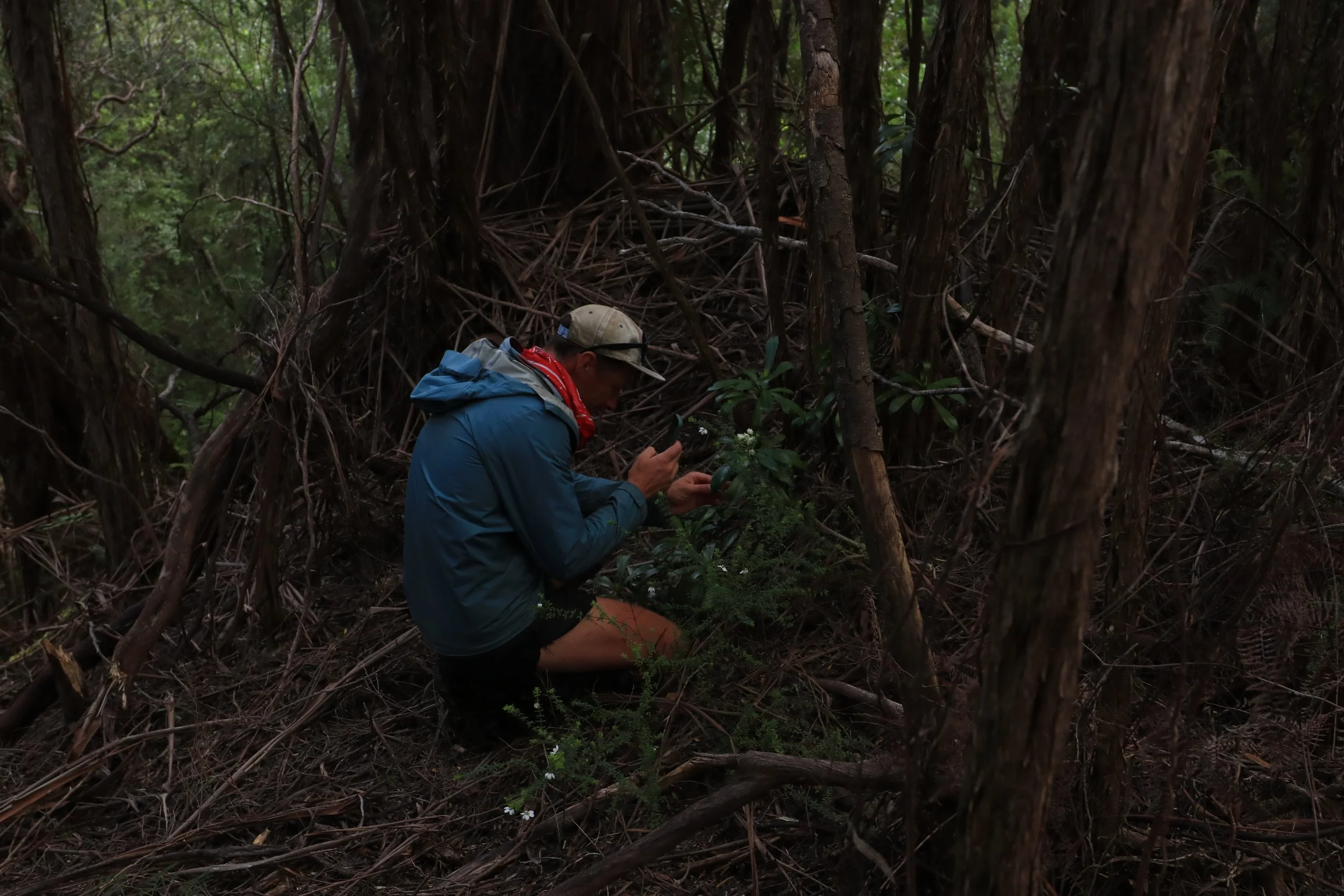
My friends and I had one of those special weeks on the South Coast Track recently. We had been brought together by the Tasmanian Wilderness Society and by our shared respect for the South Coast, both for the track and the broader region. Working together, we carried out a Bio Blitz. We were a ‘walks into a bar’ joke—there was an entomologist, a mathematician, a photographer, an architect, three geographers and a planner/retired hiking guide. I signed up because I thought a Bio Blitz was a smoothie, but I was out of luck. A Bio Blitz involves a week spent on Country recording species and natural values, sharing stories and blisters along the way. These blitzes are about gathering a repository of what is precious. By keeping eyes peeled, recording the sounds of the night, and flicking through identification books while waist deep in sword sedge, we started to build a better picture of what and who was out there.
For the Tasmanian Wilderness Society and anyone who values the South Coast, this blitz was an important one—the area is threatened by a proposal from Wild Bush Luxury Pty Ltd (a subsidiary of stock exchange-listed Experience Co Ltd) for six luxury lodges and associated infrastructure. (Ed: Wild has written about the proposal in our two-part series ‘Luxury Lodges = Wilderness Lost’ in Issues #178 and #179; head to wild.com.au to read the pieces online.) The impact of this proposal would not be limited to the lodges and their immediate construction and direct pollution (think grey water, plastics, light and sound); ongoing impacts could include helicopter flights for food and utility drops, waste removal and laundry services plus the construction of bridges, toilets, helipads, an upgraded track and more. This would all permanently threaten and/or degrade the natural values and the cultural heritage sites embedded in this internationally unique wilderness.
The blitz was a success, despite a quoll making off with our audio recorder in the night; while locating each of the proposed development sites—already marked out by developers with pink flagging tape—we surveyed a baffling diversity of ecosystems and species. Our group, over the week, recorded 162 species of flora and fauna.
I hadn’t walked and camped with such purpose before. With their esoteric knowledge bases and a common sense of curiosity, the group re-framed the landscape we were passing through, making it a completely different experience to the last time I walked this track. Beyond the Type 2 fun and the delicious scroggin, I saw the track this time as a web of myriad relationships, as a stronghold for declining habitat ranges, as being both vulnerable and immutable, and I saw the track as a homeland. Taking the time to see the South Coast through the eyes/echolocators/stomata/floating egg sacs of its inhabitants is stirring.
The South Coast may be considered as a precious place of wilderness for bushwalkers because it offers an escape from busy lives, a journey into wonder. (Ed’s note: See sidebar on right for some thoughts on ‘wilderness’.) To Sharnie Read—a palawa woman who runs the Tasmanian Aboriginal Centre’s rrala milaythina-ti (Strong in Country) project—this South Coast wilderness provides rich opportunities for immersive trips that allow Aboriginal Community members to continue to connect with cultural heritage, language, land, sea and sky country.
It’s a reminder that all these things are woven together and cannot be separated. With Sharnie’s perspective in mind, when I reflect on standing on the Ironbound Range looking south, watching short-tailed shearwaters soar out to the Maatsuyker Islands—land, sea and sky—it’s clear thatthe South Coast is truly precious because of those 162+ species that flourish there.
At this stage, they do so almost entirely on their terms. And this is important, because this is increasingly rare.
Wilderness matters more than ecosystem services and carbon sinks and otherways we try to calculate its value in our confused systems. It has intrinsic natural and cultural values that cannot be overstated. Wildlife and ecological systems deserve wilderness—a life undisturbed by industrial society and all of its impositions on sensory worlds. There are just some things that an orange bellied parrot should not have to deal with. They deserve to transcend us. They deserve to free of our industrial disturbances and our cacophony. To consider how this works on the South Coast, we need a straightforward, compelling litmus test for human intrusion on the more-than-human experience of wild places. A good one to play with is how we meddle with light. Darkness. Day and night. Simple stuff.
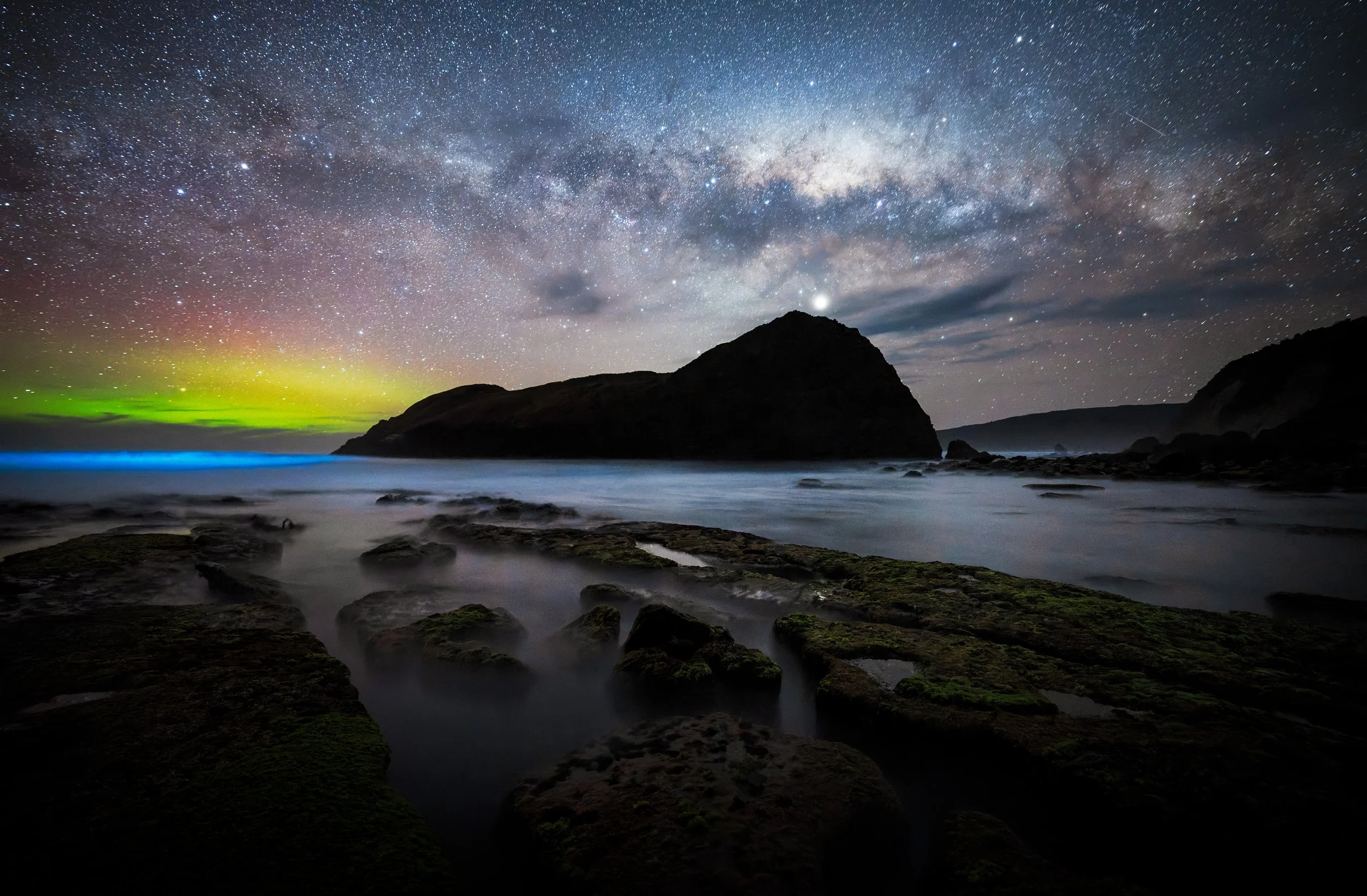
On the South Coast, dark sky and the absence of light pollution is crucial and profound. The place is a sanctuary for ecosystems running truly to night and day - the circadian rhythm as old as time. This seems a given, but this cycle is under threat across the world, because light pollution is the fastest growing form of pollution on the planet. In many parts of the world, night never truly comes; artificial lighting means the night is always brighter than a full moon. This is ok for us humans, we are diurnal, creatures of the day, so while this constant light isn’t ideal for our health in numerous ways, we can handle it. But imagine if the shoe was on the other foot. If day never came. We’d get headaches all the time from straining our eyes and toes would be stubbed. We would lose ourselves and each other in the dark. We would all end up terribly depressed. We would not flourish. In contrast, many of the creatures of the South Coast flourish at night. Attempting to comprehend, appreciate and preserve the sensory world of critters that are extremely different to us—to allow them to be—is an ultimate lesson in humility.
You and I didn’t evolve to do much in the darkness. I tested this on walks after sundown every night on the track. An hour out and an hour back each night. It’s incredibly humbling to switch off the headtorch and walk in deep, dark, moonless rainforest at night and to realise that my vision is almost completely useless, to sit with that discomfort, to fumble through an unknown world. To get completely and utterly spooked. It reinforces the sense that there are things at play that we don’t understand, and that our senses can’t perceive.
But the more time I sat with the darkness, the more I began to see. With patience and restraint, we can appreciate the full moon rising over kripikara/Cox’s Bight, even howl at it. We can dance under nuyina—the aurora australis. And we can hold our breath as the silhouette of a quoll pads softly around a calm cove. These moments of reverence are special and rare because collectively—in our towns, homes, office blocks and factories, with every light we install and then celebrate the resultant increased productivity and perceived safety—we are making them rarer. But as the only species on this planet to work out what the moon and the stars are, shouldn’t we be clever enough to recognise our responsibility to not ruin them as navigational tools and seasonal triggers for everyone else?
It should be celebrated that at night, the South Coast forest is a dark, wild space existing on the terms of the myrtle, the quoll and the devil. We should rejoice that marsupial breeding seasons on the South Coast aren’t confused and interrupted by artificial light, as has been recorded in mainland Australia. The sabotage that light pollution plays almost everywhere on the predatory dance between owl, bat and bug is not felt here. Plant, fungi and microbe and all of their myriad relationships aren’t thrown out of whack in ways we don’t comprehend. Migratory birds might be thrown off course by the lights of Geelong or a blue light disco in Huonville, and more generally by our rapidly expanding urban environments, but once they are here in the southern wilderness, things are almost as they have always been. A rhythm of night and day that species evolved to flourish with. The Southwest National Park is a sanctuary to hold gently the darkness that is being obliterated all over the world.
Which brings us back to the proposed South Coast Track development, brought about through the controversial ‘Expression of Interest’ process for tourism developments implemented by the Tasmanian State Government. Private developers often have, as it is called in developer-speak, a vision for national parks and World Heritage wilderness like the South Coast. But what matters most to them? I hazard a guess that it isn’t the finely tuned TASMANIAsensory world of the masked owl, nor the access and experience of the non-paying customer. The ‘Parks Privatisation Policy’ has allowed this inappropriate proposal that would privatise public lands to be tabled with the state government without genuine public consultation, and this is a huge worry.
The 2016 TWWHA Management Plan has a wonderful foreword from the Aboriginal Heritage Council, written by palawa man Rocky Sainty. Rocky references the stars and creatures and how they strengthen identity, since the creation of the first black person, palawa, and since the creation of the landscape: rivers, mountains, sea and sky. He refers to cultural landscapes in lutruwita/Tasmania that have remained almost as they were generations ago, and others that have been severely affected by the invasion.
After Rocky’s foreword, the management plan goes on for another 240 pages and discusses rivers, mountains and sea, but no consideration is given to how we might protect milaythina wurangkili / Sky Country from the invasion of light pollution. The story of that first black person, who came from the stars, is held at kripikara/ Cox Bight along this special track, and it should be preserved as part of the living, breathing cultural landscape. As a foundational text, the night sky, the darkness and the creatures that relate to it clearly matters to palawa/Tasmanian Aboriginal People, and together, we need to make the necessary steps in protecting it.
In contrast to the proposed inappropriate development, thoughtful management of sensory worlds and cultural landscapes might look something like a Sanctuary for Southwest Sky Country—a designated area where we commit to managing artificial light pollution and its negative impacts on the natural night. Working with Dark Sky International to certify and protect this dark place for humans and wildlife alike makes sense in the Southwest National Park, where land tenure is straightforward, and land managers and advocacy groups like Dark Sky Tasmania can work together to make simple changes to protect a large area. Once we’ve made that positive start, we could then work to expand these protections across the TWWHA and broader wilderness areas across the island. As human settlements continue to grow, wilderness can offer a reprieve for the sensory worlds of everyone—penguins, tiger snakes and bushwalkers—but only if we carefully manage them to do so.
As a generator hums, the southern boobook owl loses its ability to hear its prey. As a hut light flickers, a moth forgets to pollinate. As we put a roof between people and the stars, we subtly close a book on the story of the creation of the first palawa man. It’s all so delicate. I might be sounding a bit precious, but it is precious. In Lutruwita/Tasmania, the creeping death-by-a-thousand developments in and around wilderness areas threatens cultural landscapes and species that cling to a life and rhythm that is already shuddering under the weight of our decisions. We need to continue to learn that these places aren’t just for us; we must squint into the darkness, listen hard, and care more.